Helping people back to work, and back to themselves.
For workers compensation and life insurers, superannuation funds, claims managers, self-insured employers and rehabilitation providers.
working weeks: median time lost on a mental health claim, almost five times the median for all serious claims. 1
median compensation paid on a mental health claim, more than four times all serious claims. 1
average cost of a psychological injury claim in NSW in 2024-25, up from $146,000 in 2019-20. 2
1. Safe Work Australia, Key Work Health and Safety Statistics Australia 2025
2. NSW Treasurer, ministerial statement to the NSW Parliament, March 2025
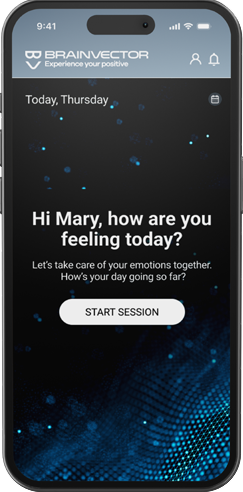
Return uses a person’s own photographs, voice, places and people to create a short immersive experience designed to support calm and confidence. It is prescribed by the treating practitioner or rehabilitation provider and runs alongside the return to work plan. Return supports treatment. It does not replace it. Where Return fits in the claim:
Early: in the first weeks of a claim, before avoidance and withdrawal set in.
Stalled claims: where progress has plateaued despite treatment.
Graduated return: short sessions before or during the first shifts back, at home or at the workplace.
Return is not an app people download. It is a programme your organisation licenses, prescribed by the treating team and produced by Brain Vector.
Clinical trials in mental health are under way.
A median mental health claim costs about $378 for every working day a person is off ($67,400 over 35.7 working weeks) (1). The more claims you put through Return, the lower the price per claim. The earlier people return, the higher the return on investment.
| Pilot: 20 claims, median claim | Result |
|---|---|
| Price per claim | $2,500 |
| Total pilot cost | $50,000 |
| Break-even: earlier return needed per claim | 6.6 working days |
| Saving if people return 30 working days earlier | $226,600 |
| ROI at 30 days earlier | 353% ($4.50 back per $1) |
| Upside: saving if people return 60 working days earlier | $453,100 |
| ROI at 60 days earlier | 806% ($9.10 back per $1) |
After the pilot. Programme pricing is set on the pilot’s results and can be linked to outcomes, so we share in the savings we help create.
Savings assume the average enrolled claim returns 30 or 60 working days earlier. ROI is the net gain as a percentage of cost. Pilot pricing covers the agreed number of claims. Brain Vector is not an insurer and does not take on any claim liability.
This is an illustrative example only. It is based on the national median mental health claim (1) and is not a quote, an actual claim cost or a guaranteed outcome. Claim costs, durations and results vary by claim, insurer and state. Our pilots measure actual outcomes.
Mental health claims across group and retail life insurance are expected to exceed $4 billion this year (3). Mental health now accounts for about a third of TPD claims paid and one in five income protection claims (4).
Getting a member back to work while they are on income protection is the best way to stop a claim becoming a permanent disability claim. Return can be offered through the fund’s group insurer as part of claims management, helping members recover and protecting the cost of cover for every member.
Four steps, shared between the treating team and ours:
The treating practitioner or rehabilitation provider sets the goal: calm, confidence or connection.
With the worker’s consent, we collect photographs, voice, places and stories and build a personal experience.
Sessions of a few minutes on shared headsets or lightweight AR glasses, wherever the worker is.
Wellbeing, mood and engagement are recorded before and after each session.
With the worker’s consent, results are shared with the treating and claims team, so progress can be read alongside the return to work plan. Taking part is voluntary and does not affect a person’s claim, treatment or employment. Sharing results is a separate choice: the person decides what is shared and with whom, can see everything that is shared, and can withdraw consent at any time.
Treating practitioners receive individual wellbeing, mood and engagement results
Claims teams receive a progress summary agreed with the person, read alongside the return to work plan
Employers and partner organisations receive aggregated, de-identified reporting only
Consent, privacy by design and Australian data handling throughout
We are inviting a small number of insurers, claims managers and self-insured employers to run a paid pilot. Each pilot compares participants with a matched group and tracks time to return to work and claim cost.
Partner with us: EAP providers, superannuation funds and claims management partners can find out about partnering with Brain Vector.
We are inviting a small number of insurers, claims managers and self-insured employers to run a paid pilot. Each pilot compares participants with a matched group and tracks time to return to work and claim cost.
(1) Safe Work Australia, Key Work Health and Safety Statistics Australia 2025.
(2) NSW Treasurer, ministerial statement to the NSW Parliament, March 2025.
(3) Council of Australian Life Insurers and Conexus Financial, reported by Investment Magazine, March 2026.
(4) Council of Australian Life Insurers and KPMG, Cause of Claims Results 2024 (retail life insurance).